 VoyaBear


Dublin in 2026: a compact capital where Viking history, Georgian elegance, and world-class pubs collide with cutting-edge tech, a red-hot food scene, and fresh May evening sun on the Liffey. Here's your complete guide.
🗽 Why Dublin Is Worth Visiting in 2026
World-class pub culture: Over 750 pubs in the city, including Ireland's oldest (The Brazen Head, est. 1198) — each with its own character, live trad sessions, and proper pints of stout
Compact walkability: Most major attractions sit within a 15-minute walk of each other, with the entire coastal tram (DART) network accessible from city centre
Historic depth: From 9th-century illuminated manuscripts at Trinity College to the harrowing cells of Kilmainham Gaol — Dublin tells Ireland's story in layers
Vibrant food renaissance: New openings in 2026 — Scéal Bakery's return to Dublin 8, expanding Spitalfields Market, and the launch of Dublin by Dusk (extended evening hours from May 2026) — make eating out more exciting than ever
🏙️ 8 Essential Dublin Experiences
1. Trinity College & The Book of Kells — Ireland's Greatest Treasure

Step through the archway onto cobblestoned Trinity College, founded in 1592 by Queen Elizabeth I. The centrepiece is the Old Library's Long Room — a breathtaking 65-metre barrel-vaulted hall lined with 200,000 of the library's oldest books. At its heart: the Book of Kells, a 9th-century illuminated Gospel manuscript created by Celtic monks around 800 AD, its intricate illustrations so vivid they look painted yesterday.
Why you should visit:
One of the world's most important medieval manuscripts, viewed by over 1 million visitors annually
The Long Room inspired the Jedi Archives in Star Wars — film buffs will catch the resemblance
The Old Library holds a rare copy of the 1916 Proclamation of the Irish Republic
Trinity's campus is stunningly photogenic year-round
What to do there:
Book of Kells exhibition + Old Library — €18.50 adults, €16 students
Self-guided campus tour — free, map available at gate
Science Gallery (when open) — cutting-edge interactive exhibitions, free entry
Douglas Hyde Gallery — contemporary art, free entry
Secret/local tips:
Best photo spot: The Long Room from the upper balcony (visit on the way out for fewer people)
Free alternative: Stroll the campus freely without entering the Book of Kells building
Hidden gem: The 18th-century Dining Hall serves student-priced lunches to visitors (try the salmon)
Avoid: Midday June-August queues can hit 90+ minutes; go at 9:30 AM sharp when doors open
Little-known fact: The Long Room used to have a flat ceiling — the barrel-vault was added in 1860 to reduce fire risk
Nearby eats/drinks: The Bankers Bar (2 min, €€, historic pub with sandwiches), KC Peaches on Nassau Street (3 min, €, excellent lunch bowls), Gallagher's Boxty House on Temple Bar (5 min, €€, traditional Irish potato pancakes)
2. Guinness Storehouse — Where the Black Stuff Comes Alive

Set inside a 1904 grain warehouse in the St. James's Gate Brewery, the Guinness Storehouse is shaped like a giant pint glass — seven floors wrapped around an atrium designed to hold 14.3 million pints. The self-guided tour walks through the history of Arthur Guinness's stout since 1759, the brewing process, cooperage, and advertising history. Your ticket ends with a complimentary pint at the Gravity Bar — a glass-walled 360° rooftop with the best view of Dublin.
Why you should visit:
Ireland's number one tourist attraction — 1.7+ million visitors annually for good reason
Pour your own perfect pint in the Guinness Academy and earn a certificate
Gravity Bar views span the Wicklow Mountains to Dublin Bay on clear days
Deep dive into 250+ years of Irish brewing heritage
What to do there:
Standard tour — €26 online, €30 on the door ([skip-the-line ticket](https://www.viator.com/Dublin-attractions/Guinness-Storehouse/d503-a3801?pid=Pde727894-c2e1-452d-82ea-a8ed5ff5ba2b))
Guinness Academy — included, learn the 6-step pour
Connoisseur Experience — €55, premium tasting with food pairings
1837 Bar & Brewery Tour — €41, includes rare stouts not sold elsewhere
Secret/local tips:
Best photo spot: Gravity Bar at golden hour (sunset around 21:15 in May)
Free alternative: Visit the Guinness Open Gate Brewery (free, smaller, experimental brews) — same campus, different building
Hidden gem: The Cooperage exhibit on Floor 3 — master coopers still make barrels by hand
Avoid: Weekends 11 AM-3 PM — peak crowds; visit weekday afternoons 3-5 PM
Little-known fact: Arthur Guinness signed a 9,000-year lease on the brewery at £45 per year — and it's still in effect
Nearby eats/drinks: The Brazen Head (5 min, €€, Ireland's oldest pub, est. 1198), Bunsen (8 min, €, best burger in Dublin), The Beerhouse (3 min, €€, craft beer selection)
3. Kilmainham Gaol — The Prison That Shaped a Nation
Introduction:
Dublin's most emotionally powerful attraction. Kilmainham Gaol operated from 1796 to 1924, holding everyone from child thieves to political rebels. Its cold stone corridors witnessed the executions of the 1916 Easter Rising leaders, and the prison's chapel was the site of the first Dáil Éireann meeting. The guided tour is delivered by exceptional storytellers who bring Ireland's fight for independence to life.
Why you should visit:
The most important historical site in modern Irish history
Moved the 1916 leaders: James Connolly, Patrick Pearse, Joseph Plunkett were executed here
Seen in dozens of films (including "The Wind That Shakes the Barley" and "Paddington 2")
The guided tour is widely considered Dublin's best
What to do there:
Guided tour — €8 adults, €6 students (must book online; [skip-the-line ticket](https://www.viator.com/Dublin-attractions/Kilmainham-Gaol/d503-a19450?pid=Pde727894-c2e1-452d-82ea-a8ed5ff5ba2b))
Self-guided museum exhibition — included, details the Irish revolutionary period
The 1916 corridor — see the actual cells where leaders spent their final hours
The Stonebreakers' Yard — where the executions took place
Secret/local tips:
Best photo spot: The main hall's curved windows from the top floor
Free alternative: Visit the Irish Museum of Modern Art (IMMA) across the road — housed in the former Royal Hospital Kilmainham, free admission
Hidden gem: The prison's East Wing (Victorian) has a stunning glass-and-iron roof rarely photographed
Avoid: Tours sell out days ahead — book at least 1 week in advance online
Little-known fact: Grace Gifford married Joseph Plunkett in the prison chapel just hours before his execution — she was his wife for only 6 hours before he was shot
Nearby eats/drinks: IMMA Café (2 min, €€, lovely courtyard setting), The Patriot Inn (4 min, €€, hearty Irish pub grub), Harthouse Vegan (7 min, €€, award-winning plant-based)
4. St. Patrick's Cathedral & Christ Church Cathedral — Two Towers, One Thousand Years

Dublin's two medieval cathedrals sit 500 metres apart but tell very different stories. St. Patrick's — Ireland's largest cathedral, built on the site where St. Patrick himself baptised converts in the 5th century — is the national cathedral of the Church of Ireland. Christ Church Cathedral is older, founded around 1030 by the Viking king Sitric Silkenbeard, and contains Dublin's largest crypt with mummified remains of a cat and rat caught in a 19th-century organ pipe (yes, really).
Why you should visit:
St. Patrick's was where Jonathan Swift served as Dean (1713-1745) — his grave is inside
Christ Church's crypt holds the 14th-century "Great Charter" of King John
Both feature magnificent medieval architecture with Gothic and Norman elements
St. Patrick's choir is among Ireland's oldest (est. 1432)
What to do there:
St. Patrick's Cathedral — €9 adults, €8 seniors/students (self-guided audio tour included)
Christ Church Cathedral — €10 adults, €8 concessions (includes Dublinia admission combo)
Christ Church Crypt — explore Dublin's oldest surviving structure
The Dublinia Experience (adjacent to Christ Church) — Viking and medieval Dublin, €12 adults
Secret/local tips:
Best photo spot: St. Patrick's Park south side catches cathedral spire + flower gardens perfectly
Free alternative: Attend Evensong at either cathedral (free, 5:30-6 PM most days) — world-class choral music
Hidden gem: Christ Church's 12th-century crypt entrance is through a small door on the south side — most visitors miss it
Avoid: Sunday mornings — services mean limited tourist access until 1 PM
Little-known fact: St. Patrick's Well, beside the cathedral, was where Patrick supposedly baptised 1,000+ locals in one day
Nearby eats/drinks: The Lord Edward (1 min from Christ Church, €€, historic pub), The Bank on Dame Street (3 min, €€, beautiful conversion), Gallagher's Boxty House (2 min, €€)
5. Howth Cliff Walk & Fishing Village — Dublin's Coastal Escape

Take the 30-minute DART train from city centre to Howth, a charming fishing village perched on a peninsula north of Dublin Bay. The cliff walks offer some of Ireland's most accessible coastal scenery — four marked trails ranging from 1.5 to 3.5 hours, with views across Dublin Bay to the Mourne Mountains. The village itself is a working fishing port with award-winning seafood.
Why you should visit:
One of the best free things to do near Dublin — stunning cliff scenery without the west coast drive time
Spot seals, dolphins, and seabirds along the cliffs
Howth Harbour still lands fresh fish daily at 4 PM
The DART journey itself hugs the coast for a scenic 25-minute ride
What to do there:
Bog of Frogs Loop — 6 km, 2 hours, moderate difficulty, best for first-timers
Cliff Path Loop — 8 km, 2.5 hours, spectacular sea views
Howth Market — weekends, local artisan food and crafts
Sea Safari rib boat tours — €35, 1-hour high-speed coastal tour
Secret/local tips:
Best photo spot: The summit at the Ben of Howth — 360° views of Dublin Bay and beyond
Free alternative: The entire cliff walk is free — pack a picnic and make a day of it
Hidden gem: The Baily Lighthouse at the tip of Howth Head — inaccessible by foot but visible from the Red Trail
Avoid: Midday weekends May-September — trails get packed; go weekday mornings
Little-known fact: Howth was the landing point for the gun-running ship the Asgard in 1914, delivering weapons for the Irish Volunteers
Nearby eats/drinks: The Oar House (€€€, catch of the day from their own boat), Beshoff Bros (€, legendary fish and chips since 1913), The Bloody Stream (€€, pub under Howth DART station)
6. The Cobblestone & Temple Bar Pub Crawl — Live Music at Its Rawest

Skip the overpriced tourist traps on Temple Bar proper and head straight to The Cobblestone in Smithfield — Dublin's most authentic trad music pub, where musicians gather nightly for spontaneous sessions that feel more like a living room jam than a performance. Then explore the surrounding historic pubs: The Stag's Head (Victorian masterpiece), The Palace Bar (established 1821, beloved by writers), and the Brazen Head (Ireland's oldest pub, since 1198).
Why you should visit:
The Cobblestone was voted one of the world's best bars — no cover charge, purely live trad
Dublin's pub culture is UNESCO-recognised as Intangible Cultural Heritage
Each historic pub has a distinct personality spanning 200+ years
Traditional music sessions happen nightly across the city
What to do there:
The Cobblestone — free trad sessions nightly from 9 PM, buy a pint (Guinness €6.50)
Self-guided historic pub crawl — Brazen Head → Stag's Head → Palace Bar → Cobblestone (all walkable in 30 min)
The Brazen Head — guided storytelling evenings Tuesdays and Thursdays, €15
Live music pub crawl — 3 hours, 4 pubs
Secret/local tips:
Best photo spot: The Stag's Head's stained-glass interior — go at 3 PM for perfect filtered light
Free alternative: Open mic sessions at The Cobblestone on Wednesday nights — completely free, world-class talent
Hidden gem: Neary's Pub on Chatham Street (no signage, look for the brass lamps) — untouched 1880s interior
Avoid: Temple Bar's central pubs on weekend nights — €8+ pints, mediocre crowds, roving hen parties
Little-known fact: The Palace Bar was the haunt of Patrick Kavanagh, Flann O'Brien, and Brendan Behan — look for their photos behind the bar
Nearby eats/drinks: The Cobblestone (Smithfield, €€), The Brazen Head (Lower Bridge Street, €€), The Winding Stair (€€€, famous Irish literature-themed restaurant overlooking the Ha'penny Bridge)
7. EPIC The Irish Emigration Museum — The Irish Diaspora's Incredible Story
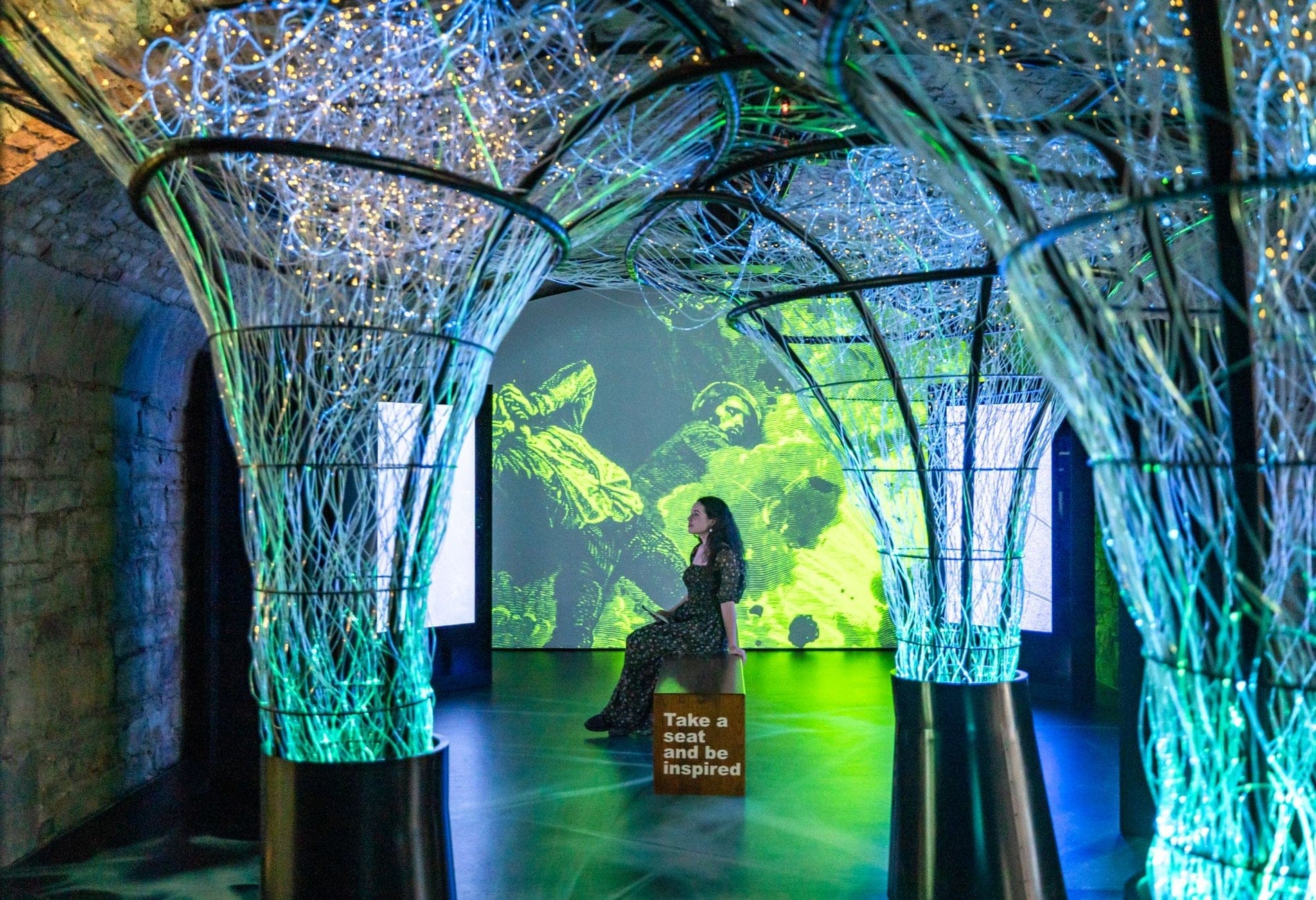
Hidden beneath the vaulted brick arches of the CHQ Building in Dublin's Docklands, EPIC is an interactive museum telling the story of the 10+ million Irish people who left their homeland. Winner of Europe's Leading Tourist Attraction at the World Travel Awards (2019 and 2020), it uses motion-activated galleries, holograms, and an AI "Irish Heritage" experience to trace Ireland's global influence.
Why you should visit:
Uniquely interactive — touchscreens tell personalised stories of Irish emigrants
Traces how 70+ million people worldwide claim Irish ancestry
The building itself is a restored 1820s bonded warehouse on the Liffey quays
The Irish Family History Centre next door can trace your Irish roots in real-time
What to do there:
Standard entry — €18.50 adults, €14.50 students (online booking saves €2)
Family History Centre add-on — €25 extra, 45-minute genealogist session
The Emigration Journey — interactive ships timeline and personal accounts
The "Irish in the World" gallery — contributions of Irish diaspora in science, politics, sports, arts
Secret/local tips:
Best photo spot: The neon "An Irish Emigrant" quote wall in Gallery 7
Free alternative: See the CHQ building exterior and docklands architecture for free
Hidden gem: The Jeanie Johnston famine ship moored right outside — €12 self-guided tour of a replica 1840s emigrant ship
Avoid: EPIC is part of the Dublin Pass, so December-weekends get busy
Little-known fact: The name "EPIC" was chosen because the Irish diaspora narrative is "a story of epic proportions" — 8 million Irish have emigrated since 1800
Nearby eats/drinks: The Bankers Bar (10 min walk, €€), The Exchequer (8 min, €€€, gastropub), The Fumbally (15 min, €€, legendary weekend brunch)
8. Phoenix Park — Europe's Largest City Park

At 1,752 acres, Phoenix Park is twice the size of London's Hyde Park. It's home to Dublin Zoo (Ireland's largest, 400+ animals), the official residence of the Irish President (Áras an Uachtaráin), and a herd of 400-600 wild fallow deer that have roamed here since the 1660s. The park's 15 km of walls enclose a mix of formal gardens, playing fields, woodland trails, and the stunning 18th-century Magazine Fort.
Why you should visit:
Europe's largest enclosed city park — more space than Central Park and Hyde Park combined
Wild deer herd visible year-round, especially at dawn and dusk
Dublin Zoo is home to the famous gorilla Kesi and the African Savanna exhibit
The People's Flower Gardens are immaculate Victorian public gardens
What to do there:
Dublin Zoo — €23 online ([skip-the-line ticket](https://www.viator.com/Dublin-attractions/Dublin-Zoo/d503-a19621?pid=Pde727894-c2e1-452d-82ea-a8ed5ff5ba2b))
Deer spotting — Papal Cross area at dusk, free
Áras an Uachtaráin tours — Saturdays only, free, ID required, book 2 weeks ahead
Phoenix Park Visitor Centre — free, interactive history of the park
Cycle through — rent a bike from Phoenix Park Bike Hire, €15 for 4 hours
Secret/local tips:
Best photo spot: The Wellington Testimonial from the East Gate — Ireland's tallest obelisk (62m)
Free alternative: The entire park is free — bring a picnic, walk the deer trails
Hidden gem: The Furry Glen — a hidden woodland trail with a tiny lake, few tourists ever find it
Avoid: Feeding the deer — it's discouraged, and fines apply
Little-known fact: Phoenix Park gets its name from the Irish "Fionn Uisce" (clear water), not the mythical bird — the name was anglicised and erroneously Latinised as "Phoenix"
Nearby eats/drinks: Phoenix Park Café (inside park, €€), Ryan's Parkgate Street (1 min from park entrance, €€, Victorian pub since 1896), The Havelock Arms (5 min, €€€, gastropub)
🗓️ 3-Day Dublin Itinerary
Day 1: Historic Heart
Morning (9:30-12:00): Trinity College + Book of Kells (arrive at opening). Grab coffee at KC Peaches
Lunch (12:00-13:00): Gallagher's Boxty House, Temple Bar
Afternoon (13:00-16:30): St. Patrick's Cathedral (1hr) → Christ Church Cathedral (1hr) → Dublin Castle tour (1hr)
Evening (17:00+): Historic pub crawl — Brazen Head → Stag's Head → Palace Bar. Dinner at The Bankers Bar. Trad session at The Cobblestone from 9 PM
Day 2: Coastal Escape
Morning (9:00-13:00): DART to Howth (30 min). Cliff Path Loop walk (2.5 hrs). Fresh seafood lunch at The Oar House
Afternoon (14:00-17:00): Return to city. Visit Kilmainham Gaol (must pre-book, 1.5-hr tour). Explore IMMA across the road
Evening: Dinner in Portobello or Camden Street (try Harthouse Vegan or Bunsen burger). Nightcap at The Bernard Shaw pub
Day 3: Modern Dublin & Green Spaces
Morning (9:30-12:30): Phoenix Park — cycle to the deer, see Dublin Zoo or visit Áras an Uachtaráin (Saturday only)
Lunch (12:30-14:00): Ryan's Parkgate Street — Victorian pub with carvery
Afternoon (14:00-17:00): EPIC Museum (1.5 hrs). Walk the Docklands and Grand Canal. Visit the Little Museum of Dublin (reopened Jan 2026 with new exhibits)
Evening (19:00+): Farewell dinner at The Winding Stair (book ahead). Last pint at Kehoe's Pub on South Anne Street
🧠 Essential Dublin Tips
Best months: May-September for best weather; May and June have longest daylight (sunset after 21:30)
Avoid August bank holiday weekend — accommodation prices double, city is packed
Weather breakdown: Spring (Mar-May) — 8-14°C, occasional sun, pack layers. Summer (Jun-Aug) — 15-20°C, warmest months, occasional rain. Autumn (Sep-Nov) — 8-16°C, crisp and lovely September-October. Winter (Dec-Feb) — 3-8°C, quieter, lower hotel prices
Transport: Leap Card (€5, top-up at any convenience store) — covers bus, Luas tram, DART rail. Single bus fare €1.60 with card vs €2.60 cash. Taxi from airport to city centre ~€25-30
Money: Ireland uses Euro. Most places accept cards, but carry €20-30 cash for small pubs and taxis
Tipping: Not mandatory but appreciated — 10-15% for table service, rounding up for pubs. Tipping taxi drivers is rare
Safety: Dublin is very safe by European standards. Normal city precautions apply — watch phones on crowded DART trains and around Temple Bar late night
Must-try foods: Irish breakfast (full fry), traditional Irish stew, boxty (potato pancakes), coddle (Dublin's signature sausage and bacon stew), brown bread, Irish soda bread, Murphy's or Guinness ice cream
Pro tip: Almost every major attraction allows you to [book a skip-the-line tour on Viator](https://www.viator.com/Dublin/d503?pid=Pde727894-c2e1-452d-82ea-a8ed5ff5ba2b) — especially worth it for the Guinness Storehouse, Book of Kells, and Kilmainham Gaol, where peak-season queues can eat 60-90 minutes
App to download: TFI Live app for real-time Dublin Bus and Luas times — essential for navigating the city efficiently
🏨 Where to Stay in Dublin
Budget (€50-100/night): Generator Hostel (€45-75, Smithfield, stylish pods, rooftop bar, 15-min walk to city centre); Abigail's Hostel (€55-90, Temple Bar, central location, free breakfast)
Mid-Range (€100-200/night): The Hendrick Smithfield (€120-160, cool design hotel, sauna, 10 min from Guinness Storehouse); The Temple Bar Inn (€130-180, perfect location, quiet rooms despite central setting, rooftop terrace)
Luxury (€200-400+/night): The Marker Hotel (€220-350, Grand Canal Dock, rooftop bar with Dublin Bay views, spa); The Merrion Hotel (€280-450, Georgian townhouse conversion, Michelin-starred restaurant, private garden)
🎭 Beyond the Tourist Trail in Dublin
Emerging neighbourhoods: Smithfield — the coolest Dublin quarter you haven't explored, with The Cobblestone, Lighthouse Cinema, and incredible food market on Friday-Saturday. Stoneybatter — Dublin's "hipster village," a 10-minute walk from Smithfield, with indie coffee shops (Two Pups, Coffee Angel), vintage stores, and the legendary L. Mulligan Grocer pub
New openings for 2026: The Little Museum of Dublin reopened in January 2026 after extensive refurbishment — updated exhibits on Dublin's social and cultural history. Dublin by Dusk launches May 2026 — last Thursday of each month, extended evening hours at cultural venues with special events. Scéal Bakery opened a new South Circular Road location in March 2026 — arguably Dublin's best croissant
Seasonal highlights: Spring — St. Patrick's Festival (week leading to March 17), cherry blossoms in St. Stephen's Green. Summer — Longitude Festival (July, music), Dublin Fringe Festival (September). Autumn — Dublin Theatre Festival (September-October), Bram Stoker Festival (October). Winter — Dublin Christmas markets (late November-December), New Year's Eve festival with fireworks over the Liffey
❤️ Final Word + CTA
Dublin's magic isn't in its size — it's in how 1,000 years of poetry, rebellion, music, and perfect pints unfold within a 15-minute walk. Wander, linger, and let the city pull you into its rhythm.
Join VoyaBear at [www.voyabear.com](https://www.voyabear.com) for custom Dublin itineraries tailored to your travel style.
